

Industrial maintenance flying arms
Industrial maintenance flying arms are advanced aerial robotic systems designed to perform inspection, maintenance, and repair tasks in complex and hazardous industrial environments. They combine the mobility of unmanned aerial vehicles with the dexterity of robotic manipulators, allowing them to reach locations that are difficult, dangerous, or costly for human workers and traditional equipment such as scaffolding or cranes.Structurally, a typical industrial flying arm consists of a multirotor platform equipped with a multi-degree-of-freedom robotic arm, end-effectors, and a suite of sensors. The multirotor provides stable flight and precise positioning, while the robotic arm enables physical interaction with structures. End-effectors can be customized for different tasks: grippers for handling components, cleaning tools, non-destructive testing probes, or instruments for tightening bolts, applying sealant, or performing electrical measurements.One of the key advantages of these systems is their ability to operate in confined or hard-to-reach spaces, such as the upper sections of storage tanks, under bridge decks, inside large processing plants, or around offshore platforms. By hovering close to a target and extending the arm, the system can carry out contact-based tasks without the need for a person to work at height or in proximity to hazardous materials. This improves worker safety and reduces downtime associated with installing temporary access structures.Advanced control algorithms are central to the performance of industrial maintenance flying arms. Coordinated control of the aerial platform and the manipulator arm is required to maintain stability when the arm applies forces to a surface. Force and torque feedback, visual servoing, and real-time pose estimation are used to keep the system steady and accurate. Modern systems may incorporate simultaneous localization and mapping, obstacle avoidance, and autonomous mission planning to execute complex maintenance routines with minimal human intervention.Applications span several industrial sectors. In energy, flying arms can inspect and clean wind turbine blades, service power lines, or maintain components in power plants. In oil and gas, they can inspect flare stacks, pipelines, and offshore structures, performing tasks such as thickness measurements or minor repairs. In civil infrastructure, they can assess and repair bridges, tunnels, and high-rise facades, reducing the need for rope access technicians and heavy lifting equipment.From an economic perspective, industrial maintenance flying arms can lower operational costs by shortening inspection times, reducing the need for shutdowns, and minimizing labor-intensive access methods. They also enable more frequent and detailed inspections, which supports predictive maintenance strategies and extends asset life. As sensing, control, and battery technologies continue to improve, these aerial robotic systems are expected to take on increasingly complex maintenance tasks and become a standard tool in industrial asset management.
Products
Category:
-
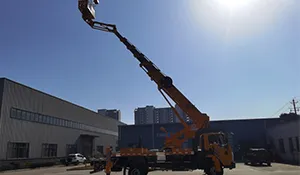
32 domestic flying arms
Category: Aerial work vehicleBrowse number: 3Number:Release time: 2026-03-24 16:47:05The 32 domestic flying arms are designed for high-altitude precision work, providing safe and stable support for aerial platforms. Their hydraulic telescopic system allows smooth extension and rotation, making them ideal for urban maintenance, industrial inspections, and construction tasks, ensuring reliable performance and operator safety during elevated operations.
News
Category:
No search results found!
Case
Category:
No search results found!
Video
Category:
No search results found!
Download
Category:
No search results found!
Job
Category:
No search results found!
Featured Products
No search results found!



 WhatsApp
 Phone
Phone