

Domestic telescopic aerial arms
Domestic telescopic aerial arms are widely used in construction, maintenance, firefighting, logistics, and industrial operations where work must be performed at height under varying reach requirements. Their core feature is a segmented boom structure that can extend and retract, allowing the working platform or tool to be positioned precisely over a wide range of heights and horizontal distances.Structurally, a telescopic aerial arm typically consists of a base frame, rotating turret, main boom sections, hydraulic or electric extension system, control system, and safety devices. The boom is made of high‑strength steel or lightweight alloy, usually in rectangular or U‑shaped cross‑sections to provide both stiffness and resistance to torsion. Multiple nested sections slide within one another, guided by wear‑resistant pads and rollers to ensure smooth motion and long service life.Extension and retraction are generally driven by hydraulic cylinders or hydraulic winch‑and‑chain systems. Hydraulic power allows for high load capacity, fine positioning, and stable movement. Flow‑control valves and proportional control technology are often used to achieve smooth acceleration and deceleration, minimizing impact and sway when starting, stopping, or changing direction. In some newer designs, electro‑hydraulic control and CAN‑bus communication support more intelligent and precise operation.The rotating turret provides 360‑degree or near‑360‑degree slewing capability. Slewing is usually powered by a hydraulic motor with a reduction gearbox, offering sufficient torque to handle full‑load operation at maximum outreach. Outriggers or stabilizers are deployed at the base to increase stability. These can be A‑type, H‑type, or X‑type, and often include automatic leveling and interlock systems, which prevent boom movement unless the equipment is properly supported.Safety is a central design consideration. Domestic telescopic aerial arms are generally equipped with load‑moment limiters, tilt sensors, height and outreach limit switches, emergency stop circuits, and overload alarms. Some models can automatically restrict boom extension or lifting speed when nearing rated capacity or when the chassis is not level. Emergency descent systems allow the platform to be safely lowered in the event of power loss or hydraulic failure.From an operational perspective, control stations are usually installed both at the base and at the platform. Dual‑station control provides flexibility and enhances safety during complex tasks. Joystick controls with clear labeling and ergonomic layout help operators quickly master basic movements such as lifting, telescoping, slewing, and platform leveling. Many products support fine proportional control to execute multiple coordinated motions simultaneously.Domestic manufacturers have made significant progress in design optimization, weight reduction, and reliability. Advanced finite‑element analysis is used to optimize boom structure, reducing overall weight while maintaining strength and stiffness. Surface treatment technologies such as shot blasting and powder coating improve corrosion resistance, enabling reliable outdoor operation under harsh weather conditions.Application scenarios are diverse. In urban construction, telescopic aerial arms are used for steel structure installation, curtain wall mounting, and facade painting. In the energy sector, they assist in power line maintenance, wind turbine servicing, and petrochemical facility inspection. Firefighting variants incorporate water cannons and rescue platforms for high‑rise emergency response. In logistics and warehousing, compact versions support high‑bay storage operations where vertical reach and maneuverability are crucial.Overall, domestic telescopic aerial arms combine robust structural design, efficient hydraulic systems, and comprehensive safety measures to provide flexible and reliable solutions for working at height. Continuous improvements in automation, remote monitoring, and intelligent safety control are further enhancing their performance and competitiveness in both domestic and overseas markets.
Products
Category:
-
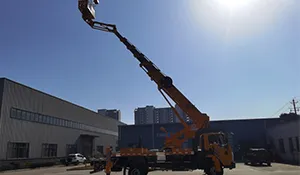
32 domestic flying arms
Category: Aerial work vehicleBrowse number: 3Number:Release time: 2026-03-24 16:47:05The 32 domestic flying arms are designed for high-altitude precision work, providing safe and stable support for aerial platforms. Their hydraulic telescopic system allows smooth extension and rotation, making them ideal for urban maintenance, industrial inspections, and construction tasks, ensuring reliable performance and operator safety during elevated operations.
News
Category:
No search results found!
Case
Category:
No search results found!
Video
Category:
No search results found!
Download
Category:
No search results found!
Job
Category:
No search results found!
Featured Products
No search results found!



 WhatsApp
 Phone
Phone