Advantages of Pure Electric Special Vehicles
Zero emissions. Pure electric vehicles use electricity as the sole power source. They produce no exhaust gas during operation and do not pollute the environment.
High energy utilization. Studies show that when the same amount of crude oil is initially refined and used for power generation, then stored in a battery and used to drive an electric vehicle, the total energy efficiency is higher than refining crude oil into gasoline and powering an internal combustion engine vehicle.
Simple structure. Since pure electric vehicles use a single source of electric power, the oil tank, engine, transmission, cooling system, and exhaust system are eliminated. Compared with the complex structure of traditional gasoline-powered drivetrains, the configuration is significantly simplified.
Low noise. Pure electric vehicles generate very low vibration and noise during operation, keeping both the interior and exterior environment quiet.
Wide range of raw energy sources. Electricity can be generated from multiple primary energy sources such as coal, nuclear energy, and hydropower, easing concerns regarding depletion of global petroleum resources.
Peak–valley electricity utilization. For power plants and grid companies, electric vehicles can be charged at night using low-cost valley electricity. This helps balance grid load differences and allows power generation equipment to operate more efficiently throughout the day, significantly improving economic benefits.
Basic Parameters of the FAW Pure Electric sprinkler truck
Model: CL5186GSSBEV
Chassis model: CA1181P62L2BEV
Wheelbase: 4500 mm
Battery type: Lithium iron phosphate
Motor type: Permanent magnet synchronous motor
Total vehicle battery capacity: 246 kWh
Charging time: 2 hours
Full-load driving range: 300 km
Superstructure water tank volume: 11 m³
Tank material: Q235 high-quality carbon steel
Rear platform material: Aluminum alloy
Side guard: Aluminum alloy
Rear guard: Q345A steel
Water pump: 60–90 / 50–110 sprinkler pump
Spraying functions: Automatic front flush, rear spray, water cannon — fully controllable via one-button operation in the cab
Water cannon range: More than 35 meters
Vehicle Basic Parameter Table
Item
Specification
|
|
Announcement model | CL5186GSSBEV pure electric sprinkler truck |
Dimensions | 9000, 8750, 8400, 8150 × 2500 × 2950 (mm) |
Chassis model | CA1181P62L2BEV |
Superstructure volume | 11 m³ |
Gross vehicle weight | 18000 kg |
Superstructure motor rated power | 30 kW |
Curb weight | 9420 kg |
Superstructure hourly energy consumption | 20 kWh |
Wheelbase | 4500 mm |
Recommended charger power | 120 kW |
Tires | 295/80R22.5 18PR |
Charging time (with recommended power) | About 2 hours |
Axle count | 2 |
Full-load driving range | 300 km |
Chassis motor max power | 180 kW |
Battery type | Lithium iron phosphate |
Battery rated voltage | 540 V |
Battery brand | CATL |
Battery capacity | 246 kWh |
Fuel type | Pure electric |
1. Product Description
1.1 Product Overview
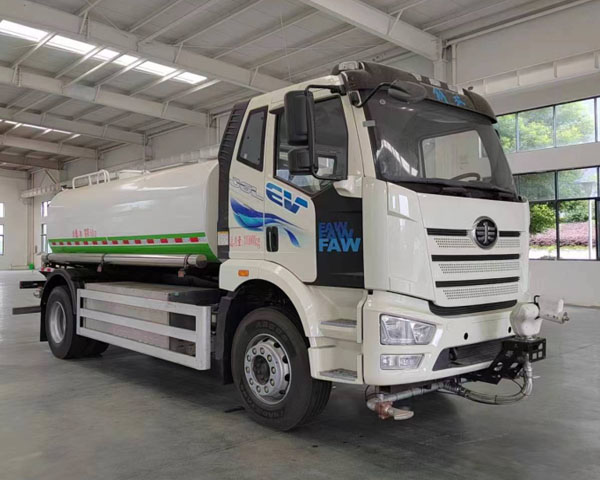
The pure electric sprinkler truck is built on a pure electric Class-II chassis and is equipped with a low-pressure washing and spraying system. It integrates mechanical, hydraulic (air circuit), and electrical components to perform professional road-sprinkling operations.
Working principle:
A self-priming two-stage centrifugal pump is used, offering high efficiency, large spraying width, and long water-gun range. The low-pressure pump is directly driven by a permanent magnet synchronous motor.
1.2 Application Scenarios
This vehicle is suitable for road maintenance and surface washing on urban main roads, highways, plazas, and similar areas. It maintains surface moisture, reduces dust, and can also be used for watering greenbelts, trees, and flowers.
Additionally, it can serve as an emergency firefighting water truck.
2. Product Performance Features
2.1 Chassis
The chassis uses the FAW pure electric Class-II platform, with optimized component matching and full compliance with national new-energy chassis regulations. It provides the following advantages:
Side-mounted power battery layout using a narrow support frame, improving compatibility with various superstructure requirements.
Cab equipped with central locking, MP5 system, wrapped aviation-style air-suspension seat, high-density cushion foam, cup holders, card slots, storage compartments, and more than 10 storage areas for comfortable driving experience.
Lightweight vehicle design with a maximum GVW of 18,000 kg.
Equipped with a large-capacity 246 kWh traction battery suitable for various sanitation vehicles such as washing units and waste-collection vehicles. The battery has a water-circulation thermal management system, ensuring stable operation in diverse environmental conditions.
2.2 Vehicle Superstructure Features
Equipped with a high-power superstructure electrical interface to support electrified sanitation equipment.
Fitted with a well-known brand self-priming two-stage centrifugal pump, offering high lift, stable quality, and reliable performance.
Front flush system uses conical nozzles with automatic control; flushing width can cover up to eight lanes.
Rear spray uses cylindrical nozzles that generate uniform fan-shaped mist with coverage up to 10 m, effectively suppressing dust.
The 360° rotatable rear water cannon can operate in jet or mist mode with a range exceeding 38 meters.
Zero pollution, low noise, eco-friendly, reduced energy consumption, and lower operating cost.
3. Main Technical Parameters
3.1 Chassis Basic Parameter Table
FAW J6L 4×2 Pure Electric Sanitation Vehicle – Suitable for Sprinkling, Washing, Garbage Transportation
Category
Item
Specification
|
|
|
Vehicle | Model | CA1181P62L2BEV |
| Dimensions (mm) | 7720 × 2495 × 2950 |
| Wheelbase (mm) | 4500 |
| Curb weight (kg) | 6560 |
| GVW (kg) | 18000 |
Power | Motor | CRRC / Permanent Magnet Synchronous |
| Rated / Peak Power (kW) | 90 / 180 |
| Rated / Peak Torque (Nm) | 500 / 1000 |
| Battery | CATL / LFP / Air-cooled |
| Rated voltage (V) | 541 |
| Battery capacity (kWh) | 246 (side-mounted) |
Performance | Max speed (km/h) | 90 |
| Max gradeability (%) | 25 |
| Acceleration 0–70 km/h (s) | 30 |
| Range (km) | 251 |
3.2 Special Vehicle Parameter Table
Item
Specification
|
|
Tank thickness / coating | 4.5 mm (internal anti-corrosion coating) |
Tank dimensions (mm) | 4400 × 2200 × 1400 |
Tank approved / maximum volume (m³) | 9.45 / 11.5 |
Tank material | Q235 carbon steel (optional stainless steel) |
Superstructure motor type | Permanent magnet synchronous |
Cooling method | Water-cooled |
Pipeline diameter | Main 65 mm; auxiliary 50 mm |
Drive method | PM motor drive; real-time speed control independent of chassis driveline |
Low-pressure pump type | Two-stage centrifugal |
Pump models | 50/110, 60/90 |
Pump lift | 110 m, 90 m |
Pump speed | 1480 r/min |
Water valves | Pneumatically-controlled ball valves |
Spraying width | ≥ 16 m |
Flushing width | ≥ 24 m |
Sprinkling speed | 7–20 km/h |
Water cannon range | ≥ 40 m |
Operating time | 1–2 h |
Optional equipment | Side flower-spray system, upper/lower spray, hose reel |
Complete Vehicle Technical Parameters
Item
Specification
|
|
Brand | Chengli |
Product name | Pure Electric Sprinkler Truck |
Model | CL5186GSSBEV |
GVW (kg) | 18000 |
Curb weight (kg) | 8760 |
Tank volume (m³) | 9.45 |
Dimensions (mm) | 9000, 8750, 8400, 8150 × 2550, 2500 × 2950, 2920 |
Approach / departure angles (°) | 12 / 8 |
Front / rear overhang (mm) | 1400 / 2250 |
Axle load (kg) | 6500 / 11500 |
Max speed (km/h) | 90 |
Additional notes kept exactly accurate in translation.
4. Main Structural Components
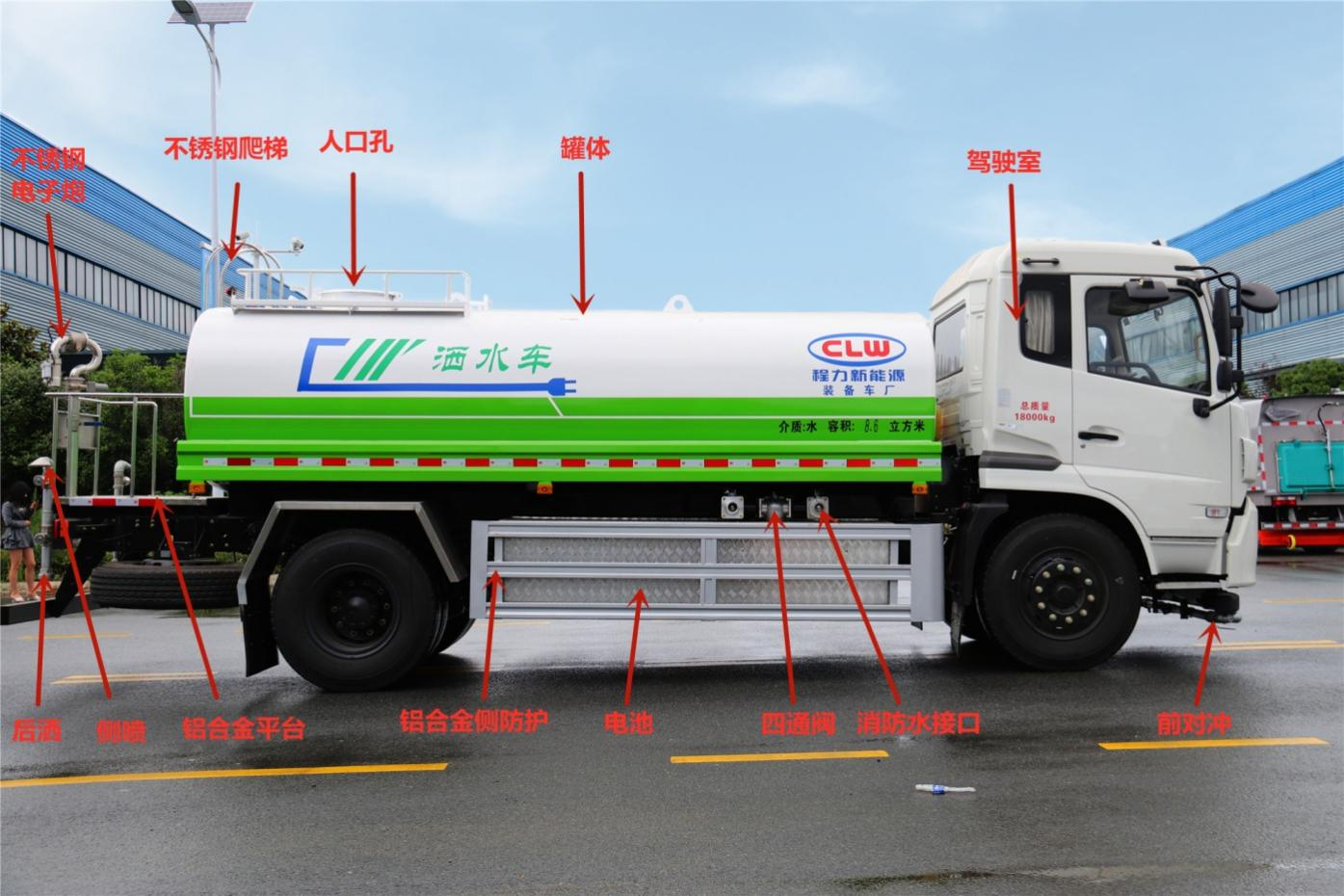
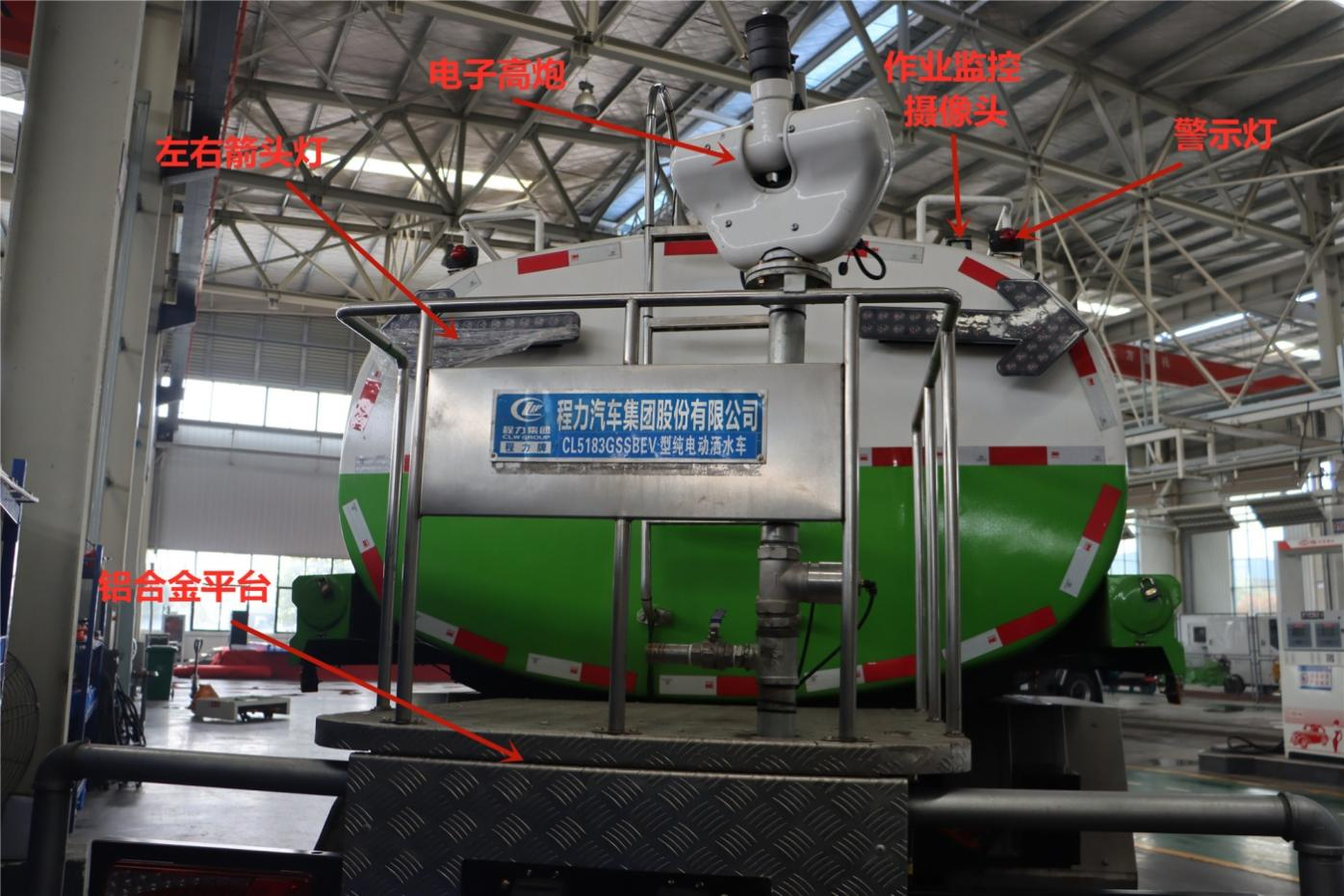
4.1 Vehicle Structure Breakdown
A complete illustration of the vehicle’s major systems, including chassis, tank, spraying system, pipelines, controllers, and electrical components.
Introduction
Pure Electric sprinkler trucks are a new generation of environmentally-friendly sanitation vehicles designed to deliver efficient road cleaning, dust suppression, irrigation, and emergency spraying capabilities without using fossil fuels. Powered entirely by batteries, these trucks combine intelligent control systems, automated spraying technologies, and high-capacity water tanks to provide zero-emission, low-noise, and high-energy-efficiency operations.
Cities around the world are experiencing rapid urbanization, leading to increased air pollution, road dust, and stricter environmental regulations. In response, municipal governments and private sanitation companies are increasingly adopting pure electric sprinkler trucks for city streets, industrial parks, public spaces, and landscaping areas.
By integrating with fleet management systems, GPS navigation, and autonomous or semi-autonomous operation features, pure electric sprinkler trucks optimize operational efficiency while reducing labor costs and environmental impact.
This comprehensive guide covers:
Definitions and classifications
Core technologies and subsystems
Structural design and chassis overview
Operational advantages and benefits
Applications and use cases
Detailed technical specifications
Maintenance and lifecycle management
Safety and compliance considerations
Market trends and future outlook
Definition and Classification
What is a Pure Electric Sprinkler Truck?
A pure electric sprinkler truck is a fully battery-powered vehicle equipped to perform water spraying tasks for cleaning, dust control, irrigation, and emergency response. Unlike diesel or gasoline-powered vehicles, it produces no exhaust emissions, operates quietly, and can integrate intelligent systems for route optimization and automated water spraying.
These trucks typically feature:
High-capacity water tanks
Self-priming pumps or centrifugal pumps
Automated spray control systems
Electric propulsion using permanent magnet synchronous motors
Optional autonomous or semi-autonomous operation
Classification by Duty and Capacity
Light-duty trucks: Compact, maneuverable vehicles for parks, campuses, and small streets. They prioritize low-speed precision and frequent, short-range operations.
Medium-duty trucks: Larger trucks for urban streets and industrial parks, balancing tank capacity, spray range, and operational flexibility.
Heavy-duty trucks: Large vehicles designed for highways, construction sites, or large-scale dust suppression, equipped with high-capacity tanks and high-pressure water cannon systems.
Classification by Autonomy
Fully autonomous trucks: Equipped with LiDAR, radar, cameras, and AI navigation for completely automated operation.
Semi-autonomous trucks: Allow operators to switch between manual, remote, and automated modes during complex scenarios.
Core Technologies
Battery and Energy Management
Pure electric sprinkler trucks rely on high-capacity lithium-ion (Li-ion) or lithium iron phosphate (LFP) batteries. Modern trucks feature smart energy management systems that monitor battery charging, discharging, thermal performance, and health status.
Fast charging support: Allows vehicles to recharge in 2–6 hours depending on charger output.
Nighttime charging: Exploits low-cost valley electricity, reducing energy costs and grid load during peak hours.
Thermal management systems: Ensure battery performance in hot and cold climates, extending service life.
Electric Drive System
Motor type: Permanent magnet synchronous motors provide high efficiency, stable torque, and low energy loss.
Regenerative braking: Captures kinetic energy during deceleration, extending battery range.
High torque output: Supports uphill operation and heavy load conditions.
Water Spraying System
Pump type: Self-priming centrifugal pumps, single or dual-stage, for reliable water flow.
Spray modes: Front flush, rear spray, side spray, fogging, and high-pressure water cannon operation.
Automatic flow control: Sensors and controllers adjust water pressure and spray width for consistent results.
Sensors and Navigation
Obstacle detection: LiDAR, ultrasonic sensors, radar, and cameras for obstacle recognition and collision avoidance.
Precision navigation: RTK GPS, inertial navigation, and route planning for automated operation.
Fleet management integration: Cloud-based platforms allow operators to monitor multiple vehicles, optimize routes, and manage water usage.
Safety Systems
Redundant braking and power systems
Emergency stop and automatic obstacle avoidance
Real-time diagnostics for motor, pump, and battery health
Structural Design
Chassis and Body
Lightweight chassis optimized for electric drivetrains
Side-mounted battery packs for weight distribution and superstructure adaptability
Aluminum alloy platforms and corrosion-resistant steel tanks for long service life
Superstructure
High-strength carbon steel or optional stainless steel water tanks
360° rotatable water cannon with adjustable spray modes
Pneumatically or electrically controlled valves for precise water flow
Automatic front flush and rear spraying systems
Operational Advantages
Zero emissions: Improves air quality and contributes to urban sustainability
Low noise: Reduces disturbances in residential and urban areas
High energy efficiency: Electric propulsion provides better energy utilization than internal combustion vehicles
Low maintenance: Fewer moving parts reduce repair costs and downtime
Operational flexibility: Vehicles can work during off-peak hours or at night
Environmental sustainability: Supports city green initiatives and reduces fuel consumption
Applications
Urban Sanitation: Cleaning city streets, roads, and plazas
Construction Sites: Dust suppression and surface washing
Landscaping: Irrigation of parks, greenbelts, and roadside plants
Industrial Areas: Road cleaning and dust control in factories and warehouses
Emergency Response: Firefighting and rapid water deployment in emergencies
Technical Specifications
General Vehicle Specifications
| Feature | Specification Range |
|---|
| Water tank capacity | 1,000 – 20,000 L |
| Drive type | Pure electric |
| Maximum speed | 20 – 60 km/h |
| Spray width | 8 – 20 m |
| Autonomy level | Semi-autonomous – Fully autonomous |
| Battery type | Li-ion or LFP |
| Battery capacity | 150 – 400 kWh |
| Charging time | 2 – 6 hours |
| Range (full load) | 200 – 400 km |
| Nozzle types | Front flush, rear spray, high-pressure cannon, fogging |
Spraying System Performance
| Feature | Specification |
|---|
| Pump type | Self-priming centrifugal, dual-stage |
| Flow rate | 50 – 500 L/min |
| Maximum pressure | 0.2 – 1.0 MPa |
| Spray modes | Wide-fan, narrow-fan, fog, column |
| Water cannon range | Up to 40 meters |
| Spray control | Manual or automatic (cab control) |
Electric Drive System
| Feature | Specification |
|---|
| Motor type | Permanent magnet synchronous |
| Rated / Peak Power | 90 – 180 kW |
| Torque | 500 – 1000 Nm |
| Battery voltage | 400 – 600 V |
| Charging interface | AC/DC fast charging |
| Energy recovery | Regenerative braking |
Operational Workflow
Task Planning: Routes, spray parameters, and timing are set via cloud or onboard systems
Autonomous Startup: Vehicle performs self-checks for sensors, pumps, and batteries
Route Execution: Guided by GPS and onboard navigation
Water Spraying: Automated flow and pressure adjustment based on sensor input
Obstacle Handling: Vehicle stops or reroutes if obstacles are detected
Completion: Vehicle returns to base for refilling, battery charging, or maintenance
Maintenance Considerations
Regular battery health monitoring and thermal management checks
Pump and nozzle inspections for wear and debris
Pipeline and valve maintenance
Software updates for sensors, navigation, and control systems
Periodic chassis and suspension inspection for long-term reliability
Market Trends and Future Outlook
Increasing adoption of fully electric sanitation fleets in urban areas
Integration with smart city IoT platforms and fleet management systems
Autonomous multi-vehicle operation for coordinated cleaning missions
Focus on energy efficiency, emission reduction, and cost-effective operation
Rising demand in developing countries for sustainable Urban Sanitation Solutions
Sustainability and Environmental Impact
Eliminates CO₂ and particulate emissions compared to diesel trucks
Reduces noise pollution in densely populated areas
Supports global energy transition and carbon neutrality goals
Enhances city reputation for eco-friendly infrastructure
Conclusion
Pure electric sprinkler trucks are revolutionizing urban sanitation and industrial dust control by combining zero-emission electric power, advanced water spraying technology, and autonomous or semi-autonomous operation.
Their modular design, advanced sensors, long-range batteries, and multi-functional spraying systems make them ideal for modern cities prioritizing sustainability, energy efficiency, and public safety.
As governments and private operators continue to adopt green municipal solutions, pure electric sprinkler trucks will remain a critical component in urban environmental management, smart city initiatives, and large-scale dust suppression projects.



 WhatsApp
 Phone
Phone